Rashonden geknoei.
Geplaatst: 27 jun 2025, 10:43
WHY CAN’T HUMANS STOP MESSING WITH DOGS?
Today our breed expert Carol Price looks at the harm we have done dogs in our constant desire to ‘improve them’
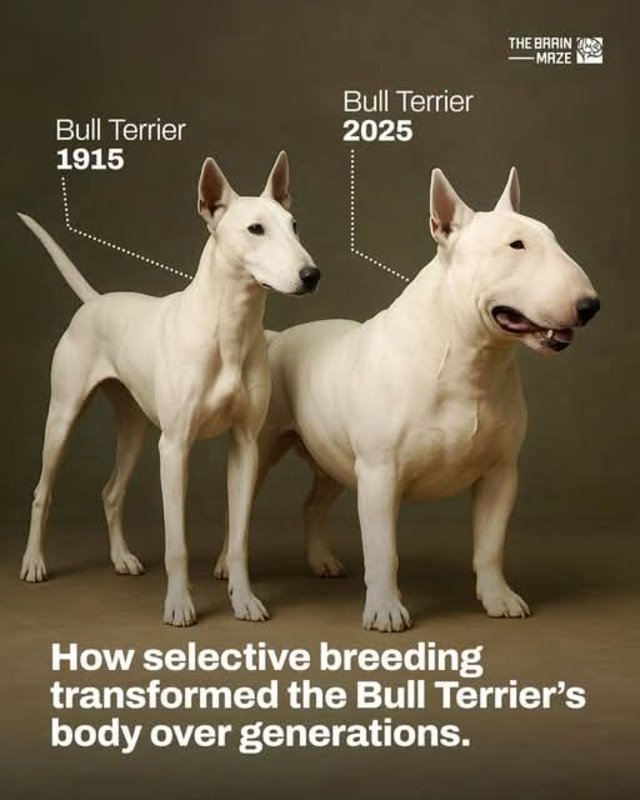
Recently I came across this picture, from The Brain Maze (a scientific site) highlighting how much the anatomy of the English bull terrier had changed, over the past century, as a direct result of human genetic selection.
“In the early 1900s”, they said, “(English) bull terriers had proportionate skulls, lean bodies, and long legs—traits suited for agility and function”. Whereas “modern bull terriers, bred for show standards, now display an arched "egg-shaped" skull, shortened snout, thicker neck, deep chest, and a stockier build. These changes, driven by aesthetic preferences, have introduced health issues like dental misalignments, breathing difficulties, and skeletal stress. The transformation is a clear example of how human-directed breeding can reshape a species' biology, often at the cost of functionality and health.
WHY?
There is nothing new about the changes so many pedigree dog breeds have undergone, over the past century, in order to better suit some arbitrary human preference of the time. But the question that has always fascinated me is WHY do we do it? Or what deeper impulse in humans makes them believe that the basic original design of a dog, as decreed by nature – and stress tested through countless past millennia – was simply not good enough as it was. And thus had to be constantly ‘improved’?
Because this is the impulse that has taken us down the road to where so many dogs are today with their myriad health issues. Dogs bred too small. Dogs bred too big. Dogs bred with squashed up faces and huge hanging folds of skin. Dogs with over-long backs. Dogs who can’t see properly. Dogs who can barely breathe. Dogs who can barely walk.
One of the best accounts ever of what had gone wrong in pedigree dog breeding appeared in Jemima Harrison’s 2008 ground-breaking TV documentary, ‘Pedigree Dogs Exposed’, which lead to significant changes in the way both the UK Kennel Club, and breeders, amended their approaches to canine welfare. More on the documentary here: https://en.wikipedia.org/wiki/Pedigree_Dogs_Exposed
THE BLIND SPOT
The extent to which different dog breeds have been ‘ruined’ by human genetic selection can be a highly emotive subject, not always grounded in fact – as certainly some pedigree dog breeds still remain intrinsically a lot healthier than others. And much can depend on the care with which different people breed them.
I still struggle to understand, however, the ‘blind spot’ that exists in so many people, where they simply cannot see that the ‘cuter’ or more novel appearance that exists in their dog has been created at the expense of its health and life quality and, so often, longevity too.
One of the things that most attracted me to pedigree Border collies, many years ago, was that they were one of the less ‘messed about’ breeds, originating from a far wider gene pool. Though there are some who believe that is already changing, with too much emphasis being placed on the aesthetic look of a dog (i.e. for showing) or its potential for different working/competitive functions when choosing breeding stock. Rather than the more intrinsic physical, mental and temperamental soundness those dogs carry in themselves and their lines.
But ultimately people themselves do not understand their own power. For breeders will only stop producing less healthy dogs when they stop buying them.
All text © Carol Price/Collieology 2025